By DaXem GmbH | virexbuster.de | Published: 21 May 2026
A recent case out of a German intensive care unit described what infection control specialists consider the worst-case scenario: a critically ill patient, a confirmed infection, and no identifiable transmission source. No clear contact chain. No traceable exposure event. Just a spreading pathogen and a team running out of answers.
This scenario is far from exceptional. It plays out thousands of times each year across Europe’s hospitals — and it points to a structural gap in healthcare hygiene that standard disinfection protocols alone cannot close.
Hospital-Acquired Infections: A Danger Hidden in Plain Sight
Nosocomial infections — infections acquired inside healthcare facilities — are among the leading causes of preventable death in the developed world. According to the European Centre for Disease Prevention and Control (ECDC), approximately 3.8 million patients in the EU acquire a healthcare-associated infection (HAI) every year. Around 90,000 of those infections contribute directly to the patient’s death.
Intensive care units carry the highest risk. Patients are immunocompromised. Procedures are invasive. Staff workloads are high. And pathogens — bacteria, viruses, fungi, mould — are present on every surface, every rail, every monitor, every door handle.
What makes ICU infections so difficult to contain is precisely what makes them so dangerous: the gap between cleaning events. A surface is disinfected. Within minutes it is touched again. Pathogens are reintroduced. The protection window resets to zero.
The Gap That Standard Disinfection Cannot Close
Modern hospital hygiene relies on a combination of hand hygiene, surface disinfection, and procedural protocols. These measures save lives every day. But they share a structural vulnerability: they only work at the moment they are applied.
Between disinfection cycles — which in a busy ICU may be hours apart — high-touch surfaces are contacted dozens of times. A contaminated glove. A visitor’s hand. A shared piece of equipment. Each contact is a potential transmission event, and each one is invisible to standard monitoring.
This is the gap that antimicrobial surface protection is designed to address — not by replacing disinfection, but by keeping surfaces actively antimicrobial between every cleaning event.
A Different Kind of Protection: Continuous, Residual, 24/7
VireXbuster is not a disinfectant. It is classified by the U.S. Environmental Protection Agency (EPA) as a Supplemental Residual Antimicrobial Product — a category that recognises its unique function: providing continuous, long-lasting antimicrobial activity on treated surfaces between regular disinfection events.
Applied to hard surfaces, walls, ceilings, and HVAC systems, VireXbuster’s hybrid formulation delivers broad-spectrum activity against viruses, bacteria, fungi, mould, and mildew — not only at the moment of application, but persistently over months of normal use.
In a clinical environment, this means:
- Treated bed rails, monitor housings, and nurse call buttons carry a lower pathogen burden between cleaning rounds
- Walls and ceilings in patient rooms and corridors remain actively antimicrobial around the clock
- HVAC systems — a frequently overlooked transmission pathway in enclosed clinical environments — can be treated to reduce airborne pathogen load
- The risk window between cleaning events is actively narrowed rather than left entirely unprotected
This does not replace disinfection. It works alongside it — providing a layer of continuous protection that remains active even when no cleaning staff are present.
Independently Verified. Clinically Relevant.
VireXbuster’s antimicrobial performance is validated by independent institutions:
- Fraunhofer Institute tested — one of Europe’s most respected independent research organisations confirmed its efficacy against viruses and bacteria
- BauA approved — certified by Germany’s Federal Institute for Occupational Safety and Health (Bundesanstalt für Arbeitsschutz und Arbeitsmedizin)
- QualityLabs certified as an antimicrobial product
- Dermatest “Excellent” — certified as dermatologically safe for skin contact, relevant for staff-facing applications
These certifications matter in a healthcare procurement context, where product credibility must meet clinical-grade scrutiny and internal compliance requirements.
The Right Formulation for Every Clinical Area
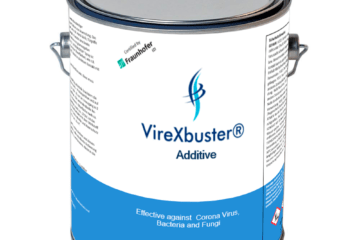
VireXbuster Spray — for hard surfaces throughout the facility: bed frames, medical equipment housings, waiting area furniture, reception desks, restrooms. Applied by spray or spray gun, transparent and odourless. Protection lasting up to 12 months under standard conditions.
VireXbuster Spray HVAC — specifically formulated for air handling units, ventilation ducts, and HVAC systems. Addresses a critical but frequently overlooked transmission pathway in enclosed clinical environments.
VireXbuster Wall — an antimicrobial waterborne wall paint for interior walls and ceilings. Turns every painted surface into a continuously active antimicrobial barrier. Ideal for patient rooms, corridors, treatment areas, and nursing stations. Not suitable for floors.
VireXbuster Duoguard — a bicomponent system engineered for the most demanding clinical environments. Unlike standard surface coatings, Duoguard withstands repeated exposure to alcohol-based disinfectants without losing antimicrobial activity — making it the correct choice for high-disinfection-frequency areas such as operating theatres, isolation rooms, and ICUs.
VireXbuster 4Bulk — an antimicrobial additive for polymer and plastic manufacturing. Used to produce antimicrobial polymer floor surfaces and equipment components for clinical environments where surface-embedded protection is required from the point of manufacture.
What Facility Managers and Infection Control Teams Can Do Today
The story of an ICU patient whose infection source cannot be identified is not an anomaly. It is a predictable consequence of a protection model that goes passive the moment cleaning stops.
Facility managers, infection control specialists, and procurement decision-makers now have an evidence-backed option to address this gap without changing their existing protocols. Adding VireXbuster requires no modification to current disinfection routines. It simply means that the surfaces in your facility are never entirely passive — they remain actively antimicrobial around the clock, every day, between every cleaning event.
Frequently Asked Questions
What is a nosocomial infection?
A nosocomial infection, also called a healthcare-associated infection (HAI), is an infection that a patient acquires during a stay in a healthcare facility and that was not present or incubating at the time of admission. They are most common in intensive care units and predominantly caused by bacteria, viruses, or fungi present on surfaces and equipment within the clinical environment.
How does VireXbuster protect hospital surfaces?
VireXbuster is applied as a coating to hard surfaces, walls, ceilings, and HVAC systems. Its hybrid formulation remains active for months after application, continuously reducing the pathogen load on treated surfaces between standard disinfection events. It does not replace disinfection — it provides supplemental residual antimicrobial protection in the gaps between cleaning cycles.
Is VireXbuster a disinfectant?
No. VireXbuster is not classified as a disinfectant. It is classified by the U.S. EPA as a Supplemental Residual Antimicrobial Product — a distinct category for products that provide persistent antimicrobial activity on surfaces over an extended period. In Europe, VireXbuster is approved by BauA (Germany’s Federal Institute for Occupational Safety and Health) and certified by QualityLabs as an antimicrobial product.
Which VireXbuster product is recommended for ICUs and operating theatres?
VireXbuster Duoguard is specifically engineered for high-disinfection-frequency clinical environments. Unlike standard antimicrobial coatings, Duoguard maintains its antimicrobial efficacy after repeated exposure to alcohol-based disinfectants — the standard cleaning agents used in ICUs, isolation rooms, and operating theatres. VireXbuster Wall can also be applied to walls and ceilings in these areas.
Does VireXbuster require changes to existing hospital cleaning protocols?
No. VireXbuster is applied once and works continuously in the background. Existing hand hygiene and surface disinfection protocols remain in place and unchanged. VireXbuster adds a supplemental layer of protection between disinfection events without disrupting established hygiene routines or requiring additional staff training.
What certifications does VireXbuster hold?
VireXbuster is Fraunhofer Institute tested for antimicrobial efficacy, BauA approved (Germany), QualityLabs certified as an antimicrobial product, and Dermatest certified as dermatologically safe with an “Excellent” rating. These independent certifications are available for review in procurement and compliance processes.
Contact Us
DaXem GmbH works directly with healthcare facilities, facility management companies, hospital procurement teams, and hygiene service providers across Germany and Europe. We provide technical guidance on product selection, application methods, surface compatibility, and integration with existing hygiene protocols.
Contact us at virexbuster.de or visit our shop to request a sample, a datasheet, or a facility assessment.
VireXbuster is an independently certified antimicrobial surface protection solution manufactured by DaXem GmbH, 65760 Eschborn, Hessen, Germany. VireXbuster is not a disinfectant and does not replace established disinfection protocols. Fraunhofer tested · BauA approved · QualityLabs certified · Dermatest “Excellent”.