By DaXem GmbH · May 29, 2026 · 5 min read · VireXbuster Blog
Clean vs. Hygienic: The Critical Difference That Changes Everything
The short answer: A surface can look mirror-clean and still be teeming with live MRSA or Norovirus particles. “Clean” is a visual status. “Hygienic” is a biological status. The goal of modern infection control is not to make surfaces look safe — it is to engineer them to be safe, continuously, 24 hours a day.
This is the ultimate paradigm shift in facility management. There is a massive, often misunderstood difference between a surface that is clean and a surface that is hygienic. Understanding this distinction is exactly why VireXbuster was engineered.
Here is the breakdown of why aiming for “clean” is a losing battle — and why “hygienic” is the only goal that actually protects people.
Clean vs. Hygienic: A Side-by-Side Breakdown
| Dimension | Clean | Hygienic |
|---|---|---|
| Status type | Visual / aesthetic condition | Biological / public health condition |
| The goal | Remove visible dirt, dust, grease, and organic matter | Eliminate and suppress invisible pathogens — viruses, bacteria, mold |
| The reality | A surface can look spotless yet still harbour millions of live MRSA or Norovirus particles | A surface is actively destroying pathogens, rendering it biologically safe to touch |
| Duration | Periodic — once a shift, once a day | Continuous — 24 hours a day, 7 days a week |
| Residual protection | None — protection ends when the cleaner evaporates | Persistent — antimicrobial action continues between cleaning events |
The Trap of Visual Cleanliness
Traditional facility management focuses heavily on making things look clean. We smell the lemon scent. We see the polished shine. Our brains falsely signal safety.
But visual cleanliness has no memory.
The second a “clean” surface dries, it becomes a passive landing pad. The next cough, the next unwashed hand, the next speck of contaminated dust instantly restores the pathogen load on that surface — even though it still looks perfectly clean to the naked eye.
This is not a housekeeping failure. It is a physics problem. No conventional cleaning agent provides residual antimicrobial action after it evaporates. The protection window is minutes, not hours. In a busy hospital corridor, a school cafeteria, or a hotel lobby, that window is meaningless.
How VireXbuster Engineers Hygiene Into the Surface
VireXbuster is not a cleaning agent. It does not wash away mud or wipe away coffee spills. Instead, it is a permanent hygiene engine built into the surface architecture itself.
Its proprietary hybrid formulation — with an exceptionally wide spectrum of activity against viruses, bacteria, fungi, mold, and mildew — bonds to the surface and remains active long after application. The result is a treated surface that is permanently hostile to microbial colonisation.
In practice, this means two things work in parallel:
- Your cleaning staff ensures the surface looks pristine — removing visible soiling, organic matter, and the bulk of contamination.
- VireXbuster ensures it stays biologically safe — neutralising any pathogen that lands between manual cleaning events.
It bridges the gap. If a pathogen lands on a VireXbuster-coated surface between cleanings, it encounters an active antimicrobial barrier — not a passive substrate.
The Golden Rule of Modern Infection Control:You clean for appearance, but you engineer for hygiene.
Where This Matters Most
The clean-vs-hygienic gap is most dangerous in high-traffic, high-touch environments:
- Healthcare: Hospital wards, outpatient clinics, care homes — where immunocompromised patients encounter surfaces dozens of times per hour.
- Hospitality: Hotel rooms, restaurant surfaces, and gym equipment that see multiple occupants per day with cleaning intervals measured in hours.
- Public Sector: Schools, public transit, government offices — where cleaning schedules cannot match footfall.
- Food & Beverage: Processing facilities where cross-contamination risk is a regulatory and safety issue simultaneously.
In every one of these environments, VireXbuster Spray, VireXbuster Wall, and VireXbuster 4Bulk provide a continuous antimicrobial layer that standard cleaning protocols alone cannot deliver.
Third-Party Verified. Independently Tested.
VireXbuster is not a marketing claim. It is a scientifically validated technology:
- BauA approved (German Federal Institute for Occupational Safety and Health)
- Fraunhofer tested — efficacy confirmed by Europe’s leading applied research institute
- QualityLabs certified — independently verified antimicrobial performance
- Dermatest rated “Excellent” — dermatologically safe for occupant exposure
- Categorised by the US EPA as a Supplemental Residual Antimicrobial Product
Frequently Asked Questions
What is the difference between a clean surface and a hygienic surface?
A clean surface is in an aesthetic condition — free of visible dirt, dust, and grease. A hygienic surface is in a biological condition — actively suppressing pathogens. A surface can appear perfectly clean yet still harbour millions of live MRSA or Norovirus particles. Hygiene is measured in microbiology, not appearance.
Why does visual cleanliness fail to protect against pathogens?
Standard cleaning agents provide no residual antimicrobial action after they evaporate. The moment a surface dries, it becomes a passive substrate. Any subsequent contact — a cough, an unwashed hand, dust — instantly recontaminates it. Visual cleanliness has no memory; biological hygiene requires continuous action.
Is VireXbuster a disinfectant?
No. VireXbuster is not a disinfectant and does not replace standard cleaning or disinfection routines. The US EPA categorises it as a Supplemental Residual Antimicrobial Product — it extends and reinforces hygiene between disinfection events by maintaining continuous antimicrobial activity on treated surfaces.
How long does VireXbuster’s antimicrobial protection last?
VireXbuster is engineered to provide long-lasting residual protection. Once applied and cured, the antimicrobial formulation bonds to the surface and remains active through normal use and routine cleaning. For specific durability data relevant to your application, contact us at virexbuster.de/contact-us.
Which VireXbuster product is right for my application?
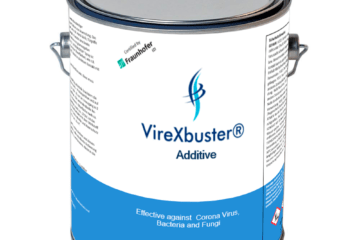
VireXbuster Spray — antimicrobial coating for hard surfaces and high-touch points. VireXbuster Wall — waterborne antimicrobial wall paint for walls and ceilings. VireXbuster 4Bulk — antimicrobial additive for polymer and plastics manufacturing, including polymer flooring. Browse the full range at virexbuster.de/shop.
Ready to engineer hygiene into your surfaces?Contact VireXbuster →
BauA approved · Fraunhofer tested · QualityLabs certified · Dermatest “Excellent” · EPA Supplemental Residual Antimicrobial Product
Clean vs. Hygienic: The Critical Difference That Changes Everything
The short answer: A surface can look mirror-clean and still be teeming with live MRSA or Norovirus particles. “Clean” is a visual status. “Hygienic” is a biological status. The goal of modern infection control is not to make surfaces look safe — it is to engineer them to be safe, continuously, 24 hours a day.
This is the ultimate paradigm shift in facility management. There is a massive, often misunderstood difference between a surface that is clean and a surface that is hygienic. Understanding this distinction is exactly why VireXbuster was engineered.
Here is the breakdown of why aiming for “clean” is a losing battle — and why “hygienic” is the only goal that actually protects people.
Clean vs. Hygienic: A Side-by-Side Breakdown
| Dimension | Clean | Hygienic |
|---|---|---|
| Status type | Visual / aesthetic condition | Biological / public health condition |
| The goal | Remove visible dirt, dust, grease, and organic matter | Eliminate and suppress invisible pathogens — viruses, bacteria, mold |
| The reality | A surface can look spotless yet still harbour millions of live MRSA or Norovirus particles | A surface is actively destroying pathogens, rendering it biologically safe to touch |
| Duration | Periodic — once a shift, once a day | Continuous — 24 hours a day, 7 days a week |
| Residual protection | None — protection ends when the cleaner evaporates | Persistent — antimicrobial action continues between cleaning events |
The Trap of Visual Cleanliness
Traditional facility management focuses heavily on making things look clean. We smell the lemon scent. We see the polished shine. Our brains falsely signal safety.
But visual cleanliness has no memory.
The second a “clean” surface dries, it becomes a passive landing pad. The next cough, the next unwashed hand, the next speck of contaminated dust instantly restores the pathogen load on that surface — even though it still looks perfectly clean to the naked eye.
This is not a housekeeping failure. It is a physics problem. No conventional cleaning agent provides residual antimicrobial action after it evaporates. The protection window is minutes, not hours. In a busy hospital corridor, a school cafeteria, or a hotel lobby, that window is meaningless.
How VireXbuster Engineers Hygiene Into the Surface
VireXbuster is not a cleaning agent. It does not wash away mud or wipe away coffee spills. Instead, it is a permanent hygiene engine built into the surface architecture itself.
Its proprietary hybrid formulation — with an exceptionally wide spectrum of activity against viruses, bacteria, fungi, mold, and mildew — bonds to the surface and remains active long after application. The result is a treated surface that is permanently hostile to microbial colonisation.
In practice, this means two things work in parallel:
- Your cleaning staff ensures the surface looks pristine — removing visible soiling, organic matter, and the bulk of contamination.
- VireXbuster ensures it stays biologically safe — neutralising any pathogen that lands between manual cleaning events.
It bridges the gap. If a pathogen lands on a VireXbuster-coated surface between cleanings, it encounters an active antimicrobial barrier — not a passive substrate.
The Golden Rule of Modern Infection Control: You clean for appearance, but you engineer for hygiene.
Where This Matters Most
The clean-vs-hygienic gap is most dangerous in high-traffic, high-touch environments:
- Healthcare: Hospital wards, outpatient clinics, care homes — where immunocompromised patients encounter surfaces dozens of times per hour.
- Hospitality: Hotel rooms, restaurant surfaces, and gym equipment that see multiple occupants per day with cleaning intervals measured in hours.
- Public Sector: Schools, public transit, government offices — where cleaning schedules cannot match footfall.
- Food & Beverage: Processing facilities where cross-contamination risk is a regulatory and safety issue simultaneously.
In every one of these environments, VireXbuster Spray, VireXbuster Wall, and VireXbuster 4Bulk provide a continuous antimicrobial layer that standard cleaning protocols alone cannot deliver.
Third-Party Verified. Independently Tested.
VireXbuster is not a marketing claim. It is a scientifically validated technology:
- BauA approved (German Federal Institute for Occupational Safety and Health)
- Fraunhofer tested — efficacy confirmed by Europe’s leading applied research institute
- QualityLabs certified — independently verified antimicrobial performance
- Dermatest rated “Excellent” — dermatologically safe for occupant exposure
- Categorised by the US EPA as a Supplemental Residual Antimicrobial Product
Frequently Asked Questions
What is the difference between a clean surface and a hygienic surface?
A clean surface is in an aesthetic condition — free of visible dirt, dust, and grease. A hygienic surface is in a biological condition — actively suppressing pathogens. A surface can appear perfectly clean yet still harbour millions of live MRSA or Norovirus particles. Hygiene is measured in microbiology, not appearance.
Why does visual cleanliness fail to protect against pathogens?
Standard cleaning agents provide no residual antimicrobial action after they evaporate. The moment a surface dries, it becomes a passive substrate. Any subsequent contact — a cough, an unwashed hand, dust — instantly recontaminates it. Visual cleanliness has no memory; biological hygiene requires continuous action.
Is VireXbuster a disinfectant?
No. VireXbuster is not a disinfectant and does not replace standard cleaning or disinfection routines. The US EPA categorises it as a Supplemental Residual Antimicrobial Product — it extends and reinforces hygiene between disinfection events by maintaining continuous antimicrobial activity on treated surfaces.
How long does VireXbuster’s antimicrobial protection last?
VireXbuster is engineered to provide long-lasting residual protection. Once applied and cured, the antimicrobial formulation bonds to the surface and remains active through normal use and routine cleaning. For specific durability data relevant to your application, contact us at virexbuster.de/contact-us.
Which VireXbuster product is right for my application?
VireXbuster Spray — antimicrobial coating for hard surfaces and high-touch points. VireXbuster Wall — waterborne antimicrobial wall paint for walls and ceilings. VireXbuster 4Bulk — antimicrobial additive for polymer and plastics manufacturing, including polymer flooring. Browse the full range at virexbuster.de/shop.
Ready to engineer hygiene into your surfaces?
Contact VireXbuster →BauA approved · Fraunhofer tested · QualityLabs certified · Dermatest “Excellent” · EPA Supplemental Residual Antimicrobial Product