Across Europe this July, infection-prevention experts keep returning to one word: resilience. Recent commentary on the future of infection control in Europe argues that the health systems best prepared for the next outbreak are the ones with strong, unglamorous everyday routines — reliable cleaning, clear reporting and consistent hygiene standards. At the same time, the European Commission has committed fresh funding to the fight against antimicrobial resistance (AMR). For managers of healthcare, transport, hospitality and manufacturing environments, one question keeps surfacing: can treated surfaces help carry part of that everyday hygiene load? Here is where antimicrobial surface coatings fit — and, just as importantly, where they do not.
Why “resilience” is the watchword in 2026
Resilience, in public-health terms, is the ability of a system to keep functioning across a wide range of scenarios. European health authorities increasingly frame stable routine processes — hygiene standards, cleaning protocols, reporting pathways — as the foundation everything else is built on. The logic is simple: you cannot surge-respond your way out of a crisis if the baseline is weak. Surfaces are part of that baseline, because high-touch points are a well-documented link in the chain of transmission for many pathogens.
The gap between cleanings
Cleaning and disinfection work — at the moment they are done. The challenge is the hours in between. A door handle, a hospital bedrail, a bus grab-pole or a shared touchscreen can be recontaminated minutes after it is wiped. This is the gap that residual antimicrobial technologies are designed to narrow: they aim to keep reducing microbial build-up on the surface between routine cleanings, rather than replacing the clean.
What a supplemental layer is — and is not
It is worth being precise. VireXbuster is not a disinfectant, and it does not replace your cleaning routine. In the United States, the EPA classifies this kind of technology as a “Supplemental Residual Antimicrobial Product” — a category explicitly distinct from disinfectants. The key word is supplemental: an added layer on top of good hygiene, not a substitute for it.
Where VireXbuster fits
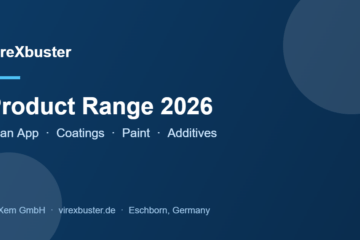
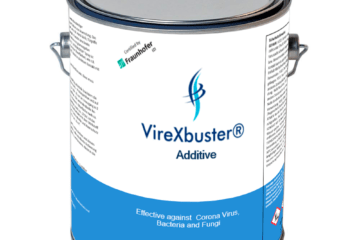
VireXbuster is built around a hybrid formulation with a very wide spectrum of activity against viruses, bacteria, fungi, mould and mildew. It comes in three formats for three different jobs:
- VireXbuster Spray — an antimicrobial coating applied to existing surfaces (metals, plastics, hard and soft substrates), with protection lasting up to 12 months per application. Used in hospitals, offices, public transport and other public spaces.
- VireXbuster 4Bulk — an additive mixed into plastic pellets during extrusion or injection moulding. Stable up to 300 °C, it embeds antimicrobial protection directly into finished polymer products, including polymer floors, for years.
- VireXbuster Wall — a waterborne antimicrobial paint for walls and ceilings (not floors), applied like any normal wall paint, for clinics, offices, bedrooms and more.
Certifications that back it up
For buyers who need more than a claim, VireXbuster’s independent credentials matter: it is BAuA approved (the German Federal Institute for Occupational Safety and Health), Fraunhofer tested, QualityLabs certified as antimicrobial, and Dermatest certified “Excellent” for dermatological safety. In a market where “antimicrobial” is sometimes used loosely, third-party validation is what separates a marketing word from a measured property.
The takeaway
Europe’s infection-prevention conversation in 2026 is about layering defences so the whole system is more resilient. Antimicrobial surface coatings are one practical layer — not a silver bullet, but a way to keep high-touch surfaces working for you between cleanings. If you manage a healthcare, transport, hospitality or manufacturing environment, it is a layer worth understanding. You can explore the full range in the VireXbuster online shop.
Frequently asked questions
Is VireXbuster a disinfectant?
No. VireXbuster is not a disinfectant and is not EPA-registered. It is a supplemental antimicrobial coating designed to work between routine cleanings; the EPA classifies this category as a “Supplemental Residual Antimicrobial Product,” distinct from disinfectants.
How long does one application last?
VireXbuster Spray provides protection lasting up to 12 months per application. VireXbuster 4Bulk, because it is embedded into the polymer during manufacturing, protects the product for years.
Where can I buy VireXbuster?
All three products — Spray, 4Bulk and Wall — are available in the VireXbuster online shop.