By DaXem GmbH | virexbuster.de | Published: 20 July 2026
Hospital high-touch surfaces are getting fresh scrutiny in 2026. DaXem GmbH, based in Eschborn, Germany, develops VireXbuster® — a hybrid antimicrobial surface technology sold today via webshop and direct sales across Europe. As hospitals reassess how they protect these hospital high-touch surfaces between cleaning cycles, it is worth looking at where the incumbent approaches fall short, and what a hybrid coating adds.
Why Hospital High-Touch Surfaces Are Back in the Spotlight in 2026
The World Health Organization estimates that healthcare-associated infections (HAIs) affect millions of patients across the EU/EEA every year, and antimicrobial resistance is making the consequences more severe: resistant organisms that reach a patient through a contaminated surface have fewer treatment options once an infection takes hold. That pressure is pushing infection-control teams to look beyond routine cleaning toward surfaces that stay protected between disinfection events — with solid copper alloys and copper-infused polymers for bed rails, door handles and IV poles cited as one of the fastest-growing responses in hospital infection control this year.
Where Copper and Single-Function Coatings Fall Short
Copper’s antimicrobial action is well established and EPA-registered in some formulations, and it has a genuine role in infection control. But as a strategy for whole-facility hospital high-touch surfaces protection, it has structural limits:
- Material-limited. Copper’s antimicrobial effect depends on direct metal-ion contact, so it only works on copper or copper-alloy surfaces — it cannot be applied to laminate, painted walls, plastic housings, or textiles, which make up most of a hospital’s contact points.
- Narrower, slower-acting spectrum. Copper’s contact-kill effect is strongest against bacteria; efficacy against viruses, fungi and mould is generally slower and less consistent, and depends heavily on humidity and surface condition.
- Cost and retrofit burden. Replacing existing hardware with solid copper or copper-clad components is a capital project, not a maintenance task — door handles, bed rails and IV poles have to be physically swapped out.
- Wears and discolours. Copper surfaces tarnish and require specific cleaning agents that preserve the antimicrobial oxide layer, adding a training and compliance burden.
Single-function antimicrobial coatings (silver-only, photocatalytic, or narrow organic biocides) share a related problem: most are optimised for one pathogen class or depend on a condition — such as UV light for photocatalytic titanium-dioxide coatings — that is not reliably present indoors.
What a Hybrid Antimicrobial Coating Adds
VireXbuster is a hybrid antimicrobial formulation with a very wide spectrum of activity against viruses, bacteria, fungi, mould and mildew — applied as a coating to virtually any surface, not only metal. Applied to a high-touch surface, it forms a durable protective layer that keeps working continuously between cleaning and disinfection events.
Important distinction: VireXbuster is not classified as a disinfectant. In the United States, the EPA defines this category as a Supplemental Residual Antimicrobial Product — it works alongside a facility’s existing disinfection protocol, not instead of it, and keeps reducing microbial load in the hours after the disinfectant has dried.
VireXbuster is independently tested and certified, not self-reported:
| Test / Certification | Issuing Body | Date | Finding |
|---|---|---|---|
| Antiviral efficacy | Fraunhofer Institute IZI (Leipzig) | Jun 2021 | 99.9% reduction against Coronavirus (ISO 21707) |
| Antibacterial efficacy | QualityLabs (Nuremberg) | Jul 2021 | 99.99% reduction against E. coli and S. aureus (ISO 22196) |
| Skin safety | Dermatest (Münster) | Jan 2022 | Rated “Excellent” — dermatologically safe |
| Product approval | BAuA (Germany) | — | Approved for use in Germany |
| Regulatory classification | U.S. EPA | — | Supplemental Residual Antimicrobial Product (not a disinfectant) |
VireXbuster is also independent of light, unlike photocatalytic coatings, and free of nanomaterials.
Real-World Results: BioLabs.io Heidelberg SL2 Laboratories
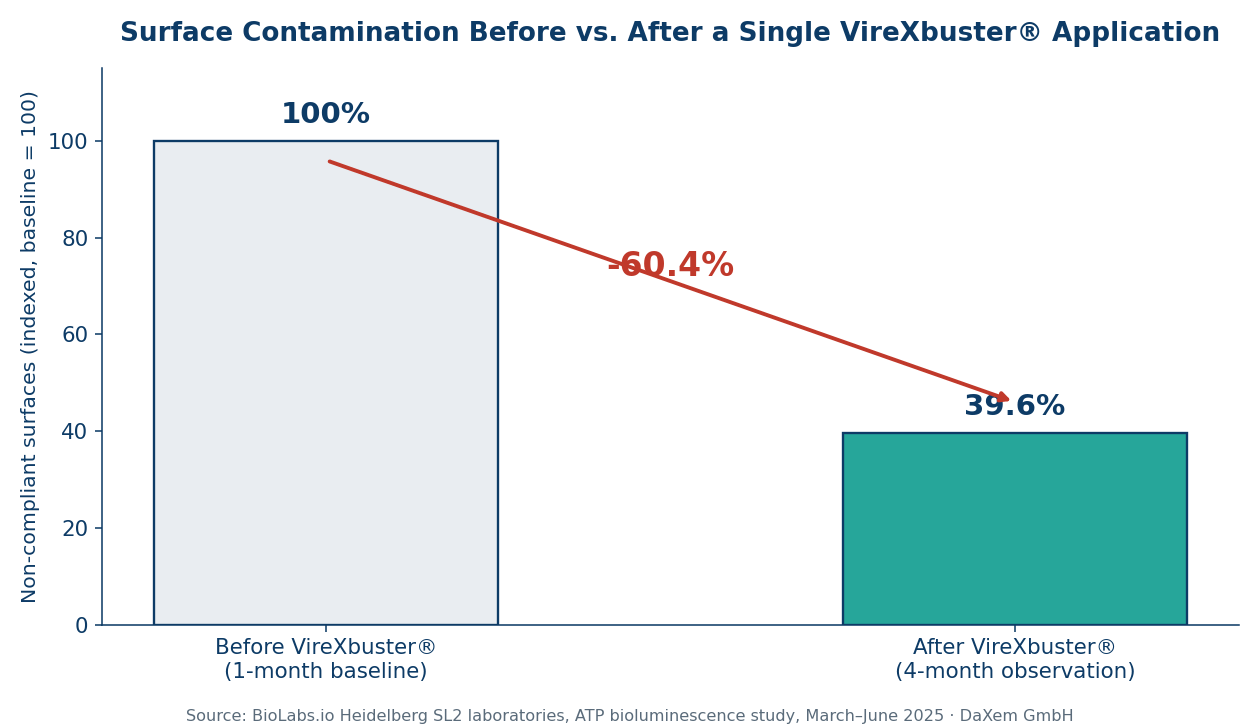
Certification testing shows what VireXbuster does in a lab. A separate, independent real-world study shows what it does in daily use. Between March and June 2025, DaXem partnered with BioLabs.io Heidelberg to monitor high-touch surfaces across two Safety Level 2 (SL2) laboratory modules and shared common areas — door handles, faucet controls, equipment surfaces, elevator buttons and more — using ATP bioluminescence (RLU) testing, the same surface-hygiene metric used in healthcare and catering hygiene audits.
SL2 laboratories already run a rigorous cleaning regime: 70% ethanol decontamination, autoclave sterilisation of waste, and strict access control. That already-high baseline makes the result more notable, not less:
| Study Parameter | Detail |
|---|---|
| Location | BioLabs.io Heidelberg, SL2 laboratories + common areas |
| Study period | March–June 2025 (4 months post-application) |
| Baseline | 1-month pre-application period (4 measurement rounds) |
| Method | ATP bioluminescence (RLU), randomised weekly sampling |
| Surfaces monitored | 20+ high-touch sites, each individually tracked |
| Result | 60.4% reduction in surfaces exceeding RLU compliance thresholds, sustained for 4 months with a single application — no re-application needed |
Source: Brega, Hausoel & Mossammad, “Long-Term Efficacy of VireXbuster® Antimicrobial Coating Evaluated by ATP Bioluminescence Monitoring in Safety Level 2 Laboratories,” DaXem GmbH & BioLabs.io Heidelberg, 2025.
Matching the Coating to Hospital High-Touch Surfaces
- VireXbuster Spray — ready-to-use coating for hospital high-touch surfaces: door handles, bed rails, IV poles, reception counters and equipment housings, regardless of material.
- VireXbuster Wall — waterborne antimicrobial paint for walls and ceilings in wards, corridors and waiting areas (not for floors).
- VireXbuster 4Bulk — an additive compounded into plastics and polymer floors, giving antimicrobial protection to moulded components and flooring from manufacture onward.
- VireXbuster HVAC — antimicrobial treatment for air-handling surfaces, reducing microbial colonisation in ventilation systems.
Because the same platform covers coating, paint and polymer additive formats, a facility is not limited to the surfaces copper can reach.
Frequently Asked Questions
Is a hybrid antimicrobial coating a replacement for copper hospital high-touch surfaces?
Not necessarily a replacement — the two can coexist. But for the majority of a facility’s high-touch surfaces, which are not made of copper, a coating like VireXbuster is the only practical option, since it can be applied to plastic, laminate, painted metal and other common materials.
Does VireXbuster replace hospital disinfection protocols?
No. VireXbuster is a supplemental residual antimicrobial, not a disinfectant. It works alongside existing cleaning and disinfection protocols, adding continuous protection on the surface between those events.
What pathogens does VireXbuster protect against?
VireXbuster has a very wide spectrum of activity against viruses, bacteria, fungi, mould and mildew — broader than most single-function coatings, which typically target one pathogen class.
Is VireXbuster safe for use in occupied clinical environments?
Yes. VireXbuster is Dermatest certified “Excellent” for dermatological safety and BAuA approved for use in Germany.
Can VireXbuster be applied to existing hospital surfaces without replacing hardware?
Yes. Unlike copper retrofits, which require physically replacing hardware, VireXbuster Spray is applied directly to existing surfaces — no capital replacement project required.
Is there independent real-world data on VireXbuster’s performance, not just lab testing?
Yes. A 2025 study at BioLabs.io Heidelberg’s SL2 laboratories measured surface contamination with ATP bioluminescence testing before and after a single VireXbuster application, over a 4-month period. Non-compliant surfaces dropped by 60.4%, with no re-application needed — even against the already-strict hygiene baseline of a certified SL2 facility.
To review technical data sheets or discuss a facility assessment, visit virexbuster.de/contact-us or browse the full product range at virexbuster.de/shop. Related reading: Antimicrobial Coating vs. Disinfectant — What’s the Difference? and Antibiotic Resistance and the Hospital Surfaces That Spread It.