An antimicrobial coating for care homes covers a gap that no cleaning schedule can close: the hours between one cleaning round and the next, when residents, staff and visitors touch the same handrails, bed frames, call buttons and door handles hundreds of times. VireXbuster is an antimicrobial surface coating, not a disinfectant. It is applied after normal cleaning and stays active 24/7 for up to 12 months, adding a continuous layer of supplemental protection alongside a care home’s existing hygiene protocol.
DaXem GmbH, based in Eschborn near Frankfurt, develops and manufactures the VireXbuster product line. It is a proprietary hybrid formulation with a very wide spectrum of activity against viruses, bacteria, fungi, mould and mildew. VireXbuster is registered with BAuA, tested by Fraunhofer, certified as antimicrobial by QualityLabs and rated “Excellent” for dermatological safety by Dermatest. Skin compatibility matters in settings where residents have fragile skin and touch the same surfaces all day.
What does an antimicrobial coating do in a care home? It forms an invisible layer on high-touch surfaces such as handrails, bed rails and call buttons. After cleaning, the layer keeps working against viruses, bacteria and fungi for up to 12 months. It supplements the care home’s disinfection routine and does not replace it.
Why Are Care Home Residents So Vulnerable to Infection?
Care homes combine the three conditions that make infections hard to contain: residents with weaker immune defences, close shared living, and constant hand contact with the same surfaces. According to the European Centre for Disease Prevention and Control (ECDC), 3.1% of residents in European long-term care facilities had at least one healthcare-associated infection on the day of the 2023–2024 point prevalence survey (HALT-4). The survey covered more than 66,000 residents in 1,097 facilities across 18 EU/EEA countries.
The ECDC reports that the most common infections were urinary tract infections, respiratory tract infections and skin infections. Among confirmed infections, the most frequently identified microorganisms were E. coli, SARS-CoV-2, Klebsiella pneumoniae and Staphylococcus aureus. The survey also found gaps in infection prevention and control: one in five facilities had no staff trained in IPC, and less than half had an IPC committee.
Autumn and winter add pressure. When the respiratory season starts, influenza, RSV and SARS-CoV-2 circulate at the same time. Care homes are where their effects on older people are most serious.
How Long Do Pathogens Survive on Care Home Surfaces?
Much longer than most people expect. A widely cited systematic review by Kramer, Schwebke and Kampf (BMC Infectious Diseases, 2006) found that many nosocomial pathogens persist on dry, inanimate surfaces for long periods:
- Influenza virus: 1–2 days
- Norovirus (and its surrogate, feline calicivirus): 8 hours to 7 days
- Staphylococcus aureus, including MRSA: 7 days to 7 months
- Escherichia coli: 1.5 hours to 16 months
- Clostridioides difficile spores: about 5 months
A handrail cleaned at 7:00 in the morning can be recontaminated by 7:15. A typical care home cleans high-touch surfaces once or twice a day, but residents and staff touch them continuously. That mismatch is the gap an antimicrobial coating is designed to address.
What Is an Antimicrobial Coating for Care Homes, and What Is It Not?
Precise language matters here, because care home managers are responsible for infection control protocols and cannot afford confusion.
- It is a supplemental residual antimicrobial coating. It is applied to clean surfaces and keeps working between cleaning cycles, 24/7, for up to 12 months.
- It is not a disinfectant. It does not replace routine cleaning, disinfection, hand hygiene or personal protective equipment. The US EPA classes products of this type as Supplemental Residual Antimicrobial Products. VireXbuster is not EPA-registered; in Germany it is registered with BAuA.
- It works as an additional layer: the disinfectant reduces the microbial load at the moment of cleaning, and the coating adds continuous protection until the next cleaning.
Efficacy data for VireXbuster refers to laboratory testing conditions. For a deeper comparison, see our facility manager’s guide to antimicrobial surface coatings.
Which Care Home Surfaces Should Be Treated First?
Start where hands go most often and where residents can’t avoid contact:
- Handrails in corridors and stairwells. Residents rely on them for balance, so they are touched continuously.
- Bed rails, bedside tables and call buttons. These are the personal high-touch zone of every resident.
- Door handles and push plates in resident rooms, dining rooms and common areas.
- Walking aids and wheelchair handles. They are shared between staff and move through the whole building.
- Sanitary fittings: taps, flush buttons, grab bars and toilet-seat lifters.
- Light switches, lift buttons and entry keypads.
- Walls and ceilings in bathrooms and sluice rooms. Humidity there encourages mould and mildew.
Surfaces that are cleaned very often with alcohol-based disinfectants need a coating built to withstand them. VireXbuster Duoguard is a two-component system designed for exactly those areas.
Which VireXbuster Products Fit a Care Home?
| Area | Product | Application |
|---|---|---|
| Handrails, door handles, bed rails, call buttons | VireXbuster® Spray 400ml | Ready-to-use spray on clean surfaces |
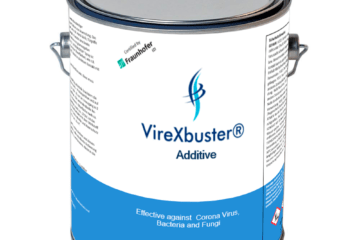
| Larger areas, whole floors of rooms | VireXbuster 1L Canister + Cordless VireXbuster Sprayer | Spray-gun application |
| Frequently alcohol-disinfected surfaces | VireXbuster Duoguard Component A+B | Two-component system |
| Walls and ceilings in bathrooms, rooms and corridors | VireXbuster Wall 5L White | Waterborne antimicrobial paint, spray gun (walls and ceilings only, not floors) |
| Ventilation and air-handling units | VireXbuster Spray HVAC 400ml | Ducts, coils, drip trays |
| Proof of treatment for residents and families | “Sanitized by VireXbuster” stickers | Visible marker on treated surfaces |
VireXbuster is not intended for food-contact surfaces, food preparation areas or drinking water. Kitchens and serving counters stay under the care home’s normal food hygiene regime.
All products are available in the VireXbuster online shop. For larger buildings or care home groups, request a quote.
How Does a Care Home Roll Out an Antimicrobial Coating?
- Map the high-touch surfaces. Walk the building with the hygiene officer and list every surface from the priority list above.
- Clean and disinfect first, using the home’s standard protocol. The coating goes onto clean, dry surfaces.
- Apply the coating. Use the spray for small items and a spray gun for large areas. Treatment can be scheduled room by room without moving residents out.
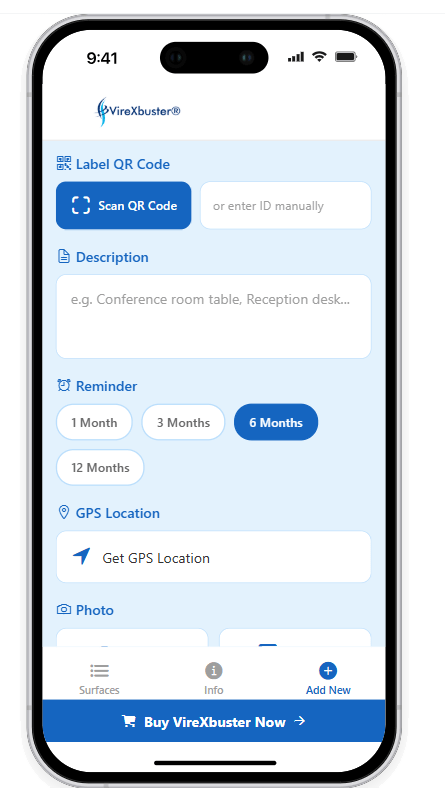
- Document every treated surface with the free VireXbuster Scan app. Record the date, location and next due date, which is useful for internal audits and inspections.
- Mark treated areas with “Sanitized by VireXbuster” stickers, so staff, residents and families can see that the extra layer is in place.
- Keep cleaning as usual. The coating works alongside the existing hygiene plan and does not change it.
The timing matters. Treating the building before the peak of the respiratory season gives the coating its longest useful window.
How Does This Fit With German Care Home Hygiene Requirements?
In Germany, hygiene in care homes follows the recommendations of the Commission for Hospital Hygiene and Infection Prevention (KRINKO) at the Robert Koch Institute and each home’s own hygiene plan under the Infection Protection Act (IfSG). Surface disinfection and hand hygiene stay mandatory. An antimicrobial coating can be added to the hygiene plan as a supplementary measure for high-touch surfaces. It is an extra layer and never a substitute.
Care home operators who also run day-care or school facilities can find the same approach in our article on antimicrobial coating for schools and kindergartens.
Frequently Asked Questions
Is VireXbuster a disinfectant?
No. VireXbuster is an antimicrobial coating that provides supplemental residual protection between cleaning and disinfection cycles. Care homes continue their normal disinfection routine, and the coating covers the hours in between.
How long does the coating last in a care home?
VireXbuster provides protection for up to 12 months. On surfaces that are cleaned very intensively, such as handrails and door handles, many facilities reapply on a fixed cycle and log it in the VireXbuster Scan app.
Is it safe for residents with sensitive skin?
Yes. Dermatest rated VireXbuster “Excellent” for dermatological safety. Once cured, the coating is dry, transparent and odourless.
Do residents need to leave their rooms during application?
Treatment is done room by room. Most facilities schedule it during activity or meal times, so residents return to a dry, treated room with no disruption to care.
Can the coating be used in the kitchen?
No. VireXbuster is not intended for food-contact surfaces or food preparation areas. Use it on handrails, doors, bed frames, sanitary fittings and walls.
Which certifications does VireXbuster hold?
VireXbuster is registered with BAuA, tested by Fraunhofer, certified as antimicrobial by QualityLabs and rated “Excellent” by Dermatest. It is not EPA-registered; the EPA classifies this product type as a Supplemental Residual Antimicrobial Product.
Can we also protect walls against mould?
Yes. VireXbuster Wall is a waterborne antimicrobial paint for walls and ceilings. It suits bathrooms, sluice rooms and other humid areas where mould and mildew build up. It is not intended for floors.
Get your care home ready before the respiratory season peaks.