“Dangerous virus spreading in Germany” – headlines like this are worrying many people right now. What is the Shamonda virus, how is it transmitted, and how high is the risk really? We have summarised the facts from the latest WHO report.
Key facts at a glance
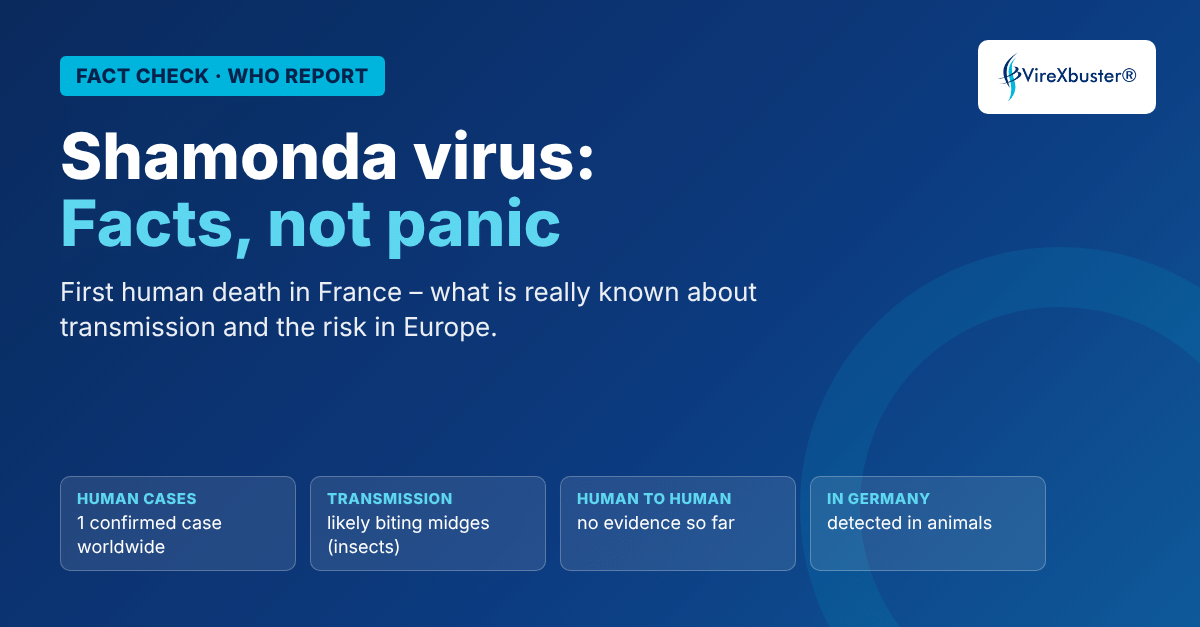
| Pathogen | Shamonda virus (SHAV), an orthobunyavirus – closely related to Schmallenberg virus |
| Human cases | 1 confirmed case worldwide (eastern France; the patient died on 8 October 2026) |
| Transmission | Most likely via tiny biting insects (midges, Culicoides); the exact route in humans is still unclear |
| Human to human | No evidence so far |
| Germany | Detected in animals (mainly cattle) since summer 2026 – no human case so far |
| Vaccine / treatment | No vaccine and no specific antiviral treatment currently available |
What is the Shamonda virus?
The Shamonda virus belongs to the orthobunyaviruses (Simbu serogroup) and to the same species as Schmallenberg virus, known to European farmers since 2011. It was first isolated from cattle in Nigeria in the 1960s and later found in animals in Africa, Japan and Europe.
According to the WHO, SHAV appeared in Europe for the first time in summer 2026 – in cattle, horses and alpacas in Belgium, France, Germany, the Netherlands and Switzerland. Further countries, including Austria, Spain and Portugal, have since reported detections in animals. Both known European variants (SHAV-EU1 and SHAV-EU2) circulate in Germany.
The first human case
On 20 October 2026, France notified the WHO of the world’s first laboratory-confirmed human infection. The patient was an older man from rural eastern France with a severely weakened immune system and serious underlying conditions. He developed neurological symptoms from 23 September and was diagnosed with severe encephalitis (brain inflammation). He died on 8 October. The exact role of the infection in his death is still being investigated.
How is the virus transmitted?
In animals, SHAV is believed to be transmitted mainly by biting midges of the genus Culicoides. Direct animal-to-animal spread is considered unlikely. How the French patient was infected is still open: an insect bite is the most plausible hypothesis; food-borne transmission (e.g. milk from infected cows) is being investigated but is currently considered unlikely.
Important: there is so far no evidence of human-to-human transmission.
How high is the risk?
French health authorities currently see no risk for the general population. The WHO stresses that a single case is not enough to assess the risk reliably and calls for “proportionate risk communication”. A joint European risk assessment is expected at the end of November.
Good to know: as temperatures drop, midge activity in central Europe decreases significantly – so the risk of insect-borne infection tends to fall in winter.
What can you do?
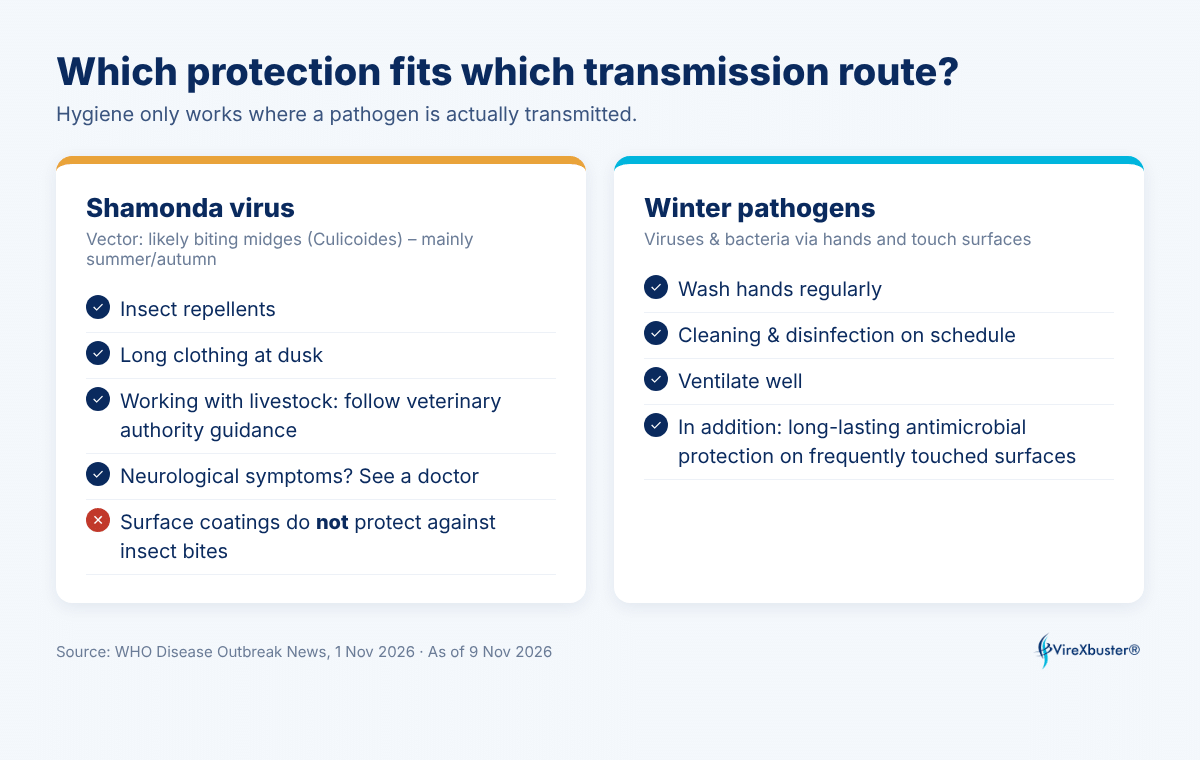
- In the warm season, use insect repellent and wear long clothing at dusk.
- If you work with cattle, sheep or horses: follow the guidance of veterinary authorities.
- If fever comes with confusion, visual disturbances or seizures, seek medical help immediately.
- Get your information from reliable sources (WHO, ECDC, health authorities) rather than headlines.
To be clear: what surface protection can – and cannot – do
As a manufacturer of antimicrobial surface protection, we say it plainly: no surface coating helps against the Shamonda virus. According to current knowledge, the virus is transmitted by insects – not via door handles or desks. VireXbuster® has not been tested against SHAV, and we do not promote it for that purpose.
The pathogens that really affect us this winter
While the Shamonda virus makes headlines, quite different pathogens will cause most sick days in the coming months: flu, cold and coronaviruses as well as bacteria. Many of them spread via hands and frequently touched surfaces – door handles, light switches, keyboards, handrails, waiting-room chairs.
This is where VireXbuster® comes in: a transparent antimicrobial coating based on a hybrid formulation with a very wide spectrum of activity against viruses, bacteria, fungi, mould and mildew. Once applied, it stays active for up to 12 months.
- Tested by Fraunhofer IZI: 99.9% reduction of SARS-CoV-2
- 99.99% reduction of bacteria
- BAuA registered (N-100947), QualityLabs certified as antimicrobial
- Dermatest “Excellent” – dermatologically tested skin-friendliness
- Patented · Made in Germany
VireXbuster® is not a disinfectant but a supplemental, long-lasting antimicrobial surface protection (in EPA terms a “Supplemental Residual Antimicrobial Product”). It does not replace regular cleaning and disinfection – it protects surfaces between cleaning intervals.
Protect touch surfaces long-term – in clinics, offices, daycare or care homes
VireXbuster® Spray is suitable for hard and soft surfaces. For larger areas and businesses, we are happy to advise you personally.
Shop VireXbuster® Spray Request adviceFrequently asked questions about the Shamonda virus
Is the Shamonda virus contagious from person to person?
According to current knowledge, there is no evidence of human-to-human transmission.
Are there human Shamonda cases in Germany?
No. In Germany, the virus has so far only been detected in animals. The only confirmed human case is from eastern France.
Is there a vaccine against the Shamonda virus?
There is currently no vaccine and no specific antiviral therapy.
Does VireXbuster® protect against the Shamonda virus?
No. The virus is believed to be transmitted by insects, not via surfaces. VireXbuster® is designed for frequently touched surfaces, through which many other viruses and bacteria are passed on.
Sources: WHO Disease Outbreak News: Shamonda virus in human – France (1 Nov 2026) · Eurosurveillance (2026) · Santé publique France · CDC Emerging Infectious Diseases. As of 9 November 2026. This article does not replace medical advice.
Use biocides safely. Always read the label and product information before use.