Cruise ship antimicrobial coating is getting fresh attention this year. Cruise ships are one of the hardest environments in the world to keep clean — and 2026’s numbers show why it stays newsworthy. CDC’s Vessel Sanitation Program logged outbreaks on ships like the Star Princess in March and the Ruby Princess in June, the latter affecting 107 passengers and 25 crew members with norovirus symptoms during a single voyage. The CDC also just expanded its VSP standards to require, for the first time, mandatory Legionella monitoring alongside stricter documentation rules — a sign regulators see environmental hygiene as core to outbreak prevention, not an afterthought to hand hygiene alone.
A cruise ship is a closed loop: thousands of guests and crew sharing cabins, corridors, elevators, dining rooms, gyms, and pools for days or weeks at a time, in a humid, salt-air environment that’s kind to mold and mildew. Housekeeping and the ship’s Outbreak Plan do the heavy lifting on active cleaning. The question is what happens to a handrail, a cabin door handle, or a crew bunk fixture in the hours between cleaning passes — when hundreds of hands and a warm, humid climate are working against it. That’s the gap VireXbuster is built to close, and on a vessel this size it takes more than one product: it takes a system of coatings, paint, manufacturing additives, and a way to track what’s been treated and when.
Cruise Ship Antimicrobial Coating for Guest-Facing Areas
In public and guest spaces, the goal is protection that disappears into the finish. VireXbuster Wall — a waterborne antimicrobial paint for walls and ceilings — can be specified for cabin corridors, elevator lobbies, and dining areas during a refurbishment or drydock cycle, adding antimicrobial activity to a surface that was getting painted anyway. VireXbuster Spray covers the fixtures paint can’t: handrails, elevator buttons, cabin door handles, gym equipment, and pool-deck furniture, with a single application holding up to 12 months of continuous activity — well past a typical sailing season between drydocks.
Crew-Only Areas: Where Function Matters More Than Finish
This is where the cruise environment gets interesting. Crew quarters, crew mess halls, laundry rooms, provisions corridors, and engine control rooms see some of the heaviest, most continuous human traffic on the entire ship — often more than guest areas, since crew live and work there in tight, shared spaces for months at a stretch. And because these are working spaces, not showcase spaces, there’s no need to match a design scheme or protect a decorative finish. That opens the door to the most durable option in the system: VireXbuster 4Bulk.
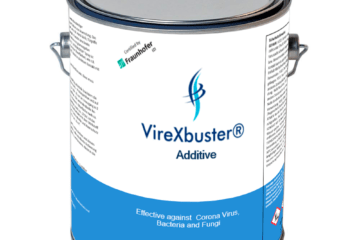
4Bulk is an antimicrobial additive built into polymer components at the manufacturing stage — mixed into plastic pellets during extrusion or injection molding, stable to 300°C. For crew corridor flooring, utility fittings, laundry room components, or galley-adjacent polymer fixtures, that means the protection is molded in from day one and lasts the working life of the part, with no reapplication schedule to track. It’s a natural fit for exactly the areas where aesthetics take a back seat to durability and uptime: crew showers, laundry facilities, and back-of-house corridors that see round-the-clock use and get refurbished far less often than guest decks.
Where existing crew-area fixtures can’t be replaced during a given drydock, VireXbuster Spray fills the same gap it does in guest areas — treating door handles, bunk rails, and shared bathroom fixtures directly, quickly, without a full refit.
Tracking: Knowing What’s Protected and When
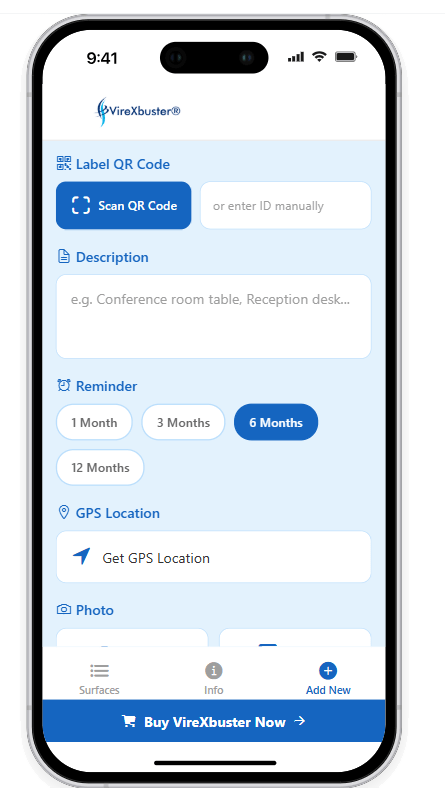
A single ship can carry thousands of individually treated surfaces spread across guest decks, back-of-house corridors, and crew quarters, with different products on different reapplication timelines — 4Bulk and Wall built in for the long term, Spray due for renewal roughly every 12 months. That’s not something a maintenance team can track from memory or a spreadsheet alone. The VireXbuster system includes an app for logging exactly which surfaces have been treated, with which product, and when they’re due for attention again, so fleet and facilities managers can plan reapplication around drydock schedules instead of guessing. On a vessel with guest zones, crew zones, and a rotating maintenance calendar, that tracking layer is what turns a set of individual applications into a coordinated, ship-wide protection plan.
Fitting the Maintenance Calendar
Cruise lines already work in fixed maintenance windows — drydock periods where cabins, corridors, and crew areas get attention that isn’t possible while a ship is sailing. VireXbuster Spray, Wall, and 4Bulk are all suited to exactly that kind of scheduled application, and the tracking app makes it straightforward to see, ahead of the next drydock, which zones are coming due for Spray renewal versus which are already covered for the life of the part.
Full product details are available at the VireXbuster shop: https://www.virexbuster.de/shop
FAQ
Does VireXbuster replace CDC Vessel Sanitation Program cleaning requirements?
No. VireXbuster is not a disinfectant and does not replace mandated cleaning and disinfection protocols. It’s a supplemental layer of protection between those cleaning cycles — in the US, the EPA places this category of product under Supplemental Residual Antimicrobial Products (SRAP), distinct from disinfectants.
Does VireXbuster hold up in a humid, salt-air marine environment?
VireXbuster is a hybrid formulation with a very wide spectrum of activity against viruses, bacteria, fungi, mold, and mildew — the kinds of microorganisms that thrive in warm, humid onboard conditions. It is BAuA approved, Fraunhofer tested, QualityLabs certified as antimicrobial, and Dermatest certified “Excellent” for dermatological safety.
Which product fits crew-only spaces where appearance isn’t a priority?
VireXbuster 4Bulk is the best fit for new or replacement polymer components — flooring, fittings, fixtures — since the protection is built in during manufacturing rather than applied to a finish. VireXbuster Spray is the faster option for treating existing crew-area surfaces without waiting for a refit.
How does a ship keep track of which surfaces are protected?
Through the VireXbuster app, which logs each treated surface, the product used, and the reapplication date, so facilities teams can plan renewals around scheduled drydock periods rather than tracking it manually.
Sources: CDC Vessel Sanitation Program, Star Princess (March 2026) and Ruby Princess (June 2026) outbreak reports; CDC-VSP 2026 Legionella monitoring update.